Mar 04, 2026
Brazil Corn Estimate Unchanged at 135.0 Million Tons
Author: Michael Cordonnier/Soybean & Corn Advisor, Inc.
Rainfall last week in Brazil favored northern locations once again with only light showers in southern areas. Dryness lingers in the southern safrinha areas especially in northern Parana and southern Sao Paulo. The forecast for this week is calling for more rainfall in northern areas and continued dryer-than-normal weather in southern areas.
Safrinha corn in Brazil was 66% planted as of late last week compared to 80% last year according to AgRural. This represents an advance of 16% for the week, but the planting remains the slowest since 2022. We are now into the month of March and approximately 35% of the safrinha corn is yet to be planted. Farmers will continue to try and plant safrinha corn until about March 10-15th. After that date, the risk of low corn yields greatly increases.
The Brazilian corn estimate was left unchanged this week at 135.0 million tons with a neutral to lower bias. With 35% of the crop left to plant, it is possible that farmers may not plant all their intended corn acreage but instead switch to an alternative crop such as grain sorghum, sunflowers, or sesame.
AgRural is estimating the Brazilian corn production at 136.2 million tons. StoneX increased their Brazilian corn production 0.5 million tons to 136.0 million. Safras & Mercado lowered their Brazilian corn production 1.0 million tons to 141.7 million.
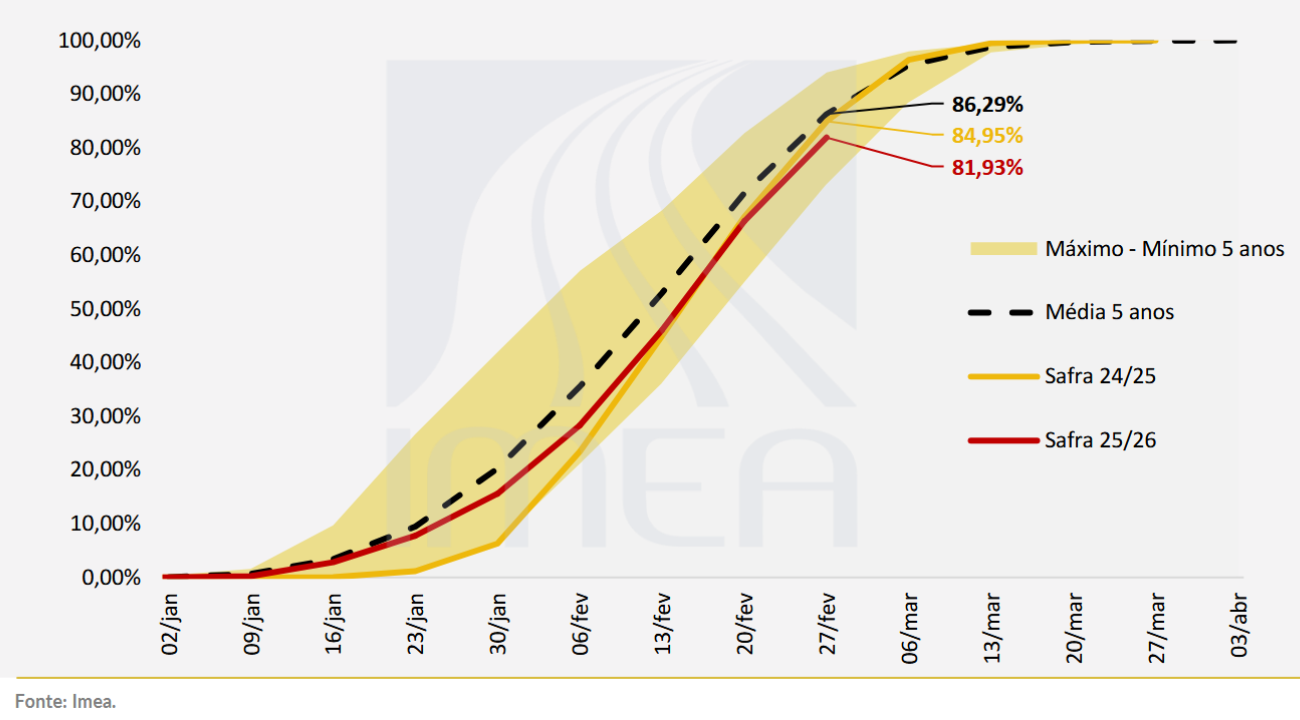
Mato Grosso - Safrinha corn in Mato Grosso was 81.9% planted as of late last week compared to 84.9% last year and 86.2% average according to the Mato Grosso Institute of Agricultural Economics (Imea). This represents an increase of 15.6% for the week. The most advanced planting is the mid-north region where 91% of the corn has been planted. The slowest planting is in the southeastern region where 57% of the corn has been planted. Below is the safrinha corn planting pace in Mato Grosso for February 27, 2026 from Imea.
Parana - Safrinha corn in Parana was 45% planted as of earlier last week compared to 65% last year according to Deral. Recent precipitation was important for establishing the crop, but more is needed especially in northern Parana.